


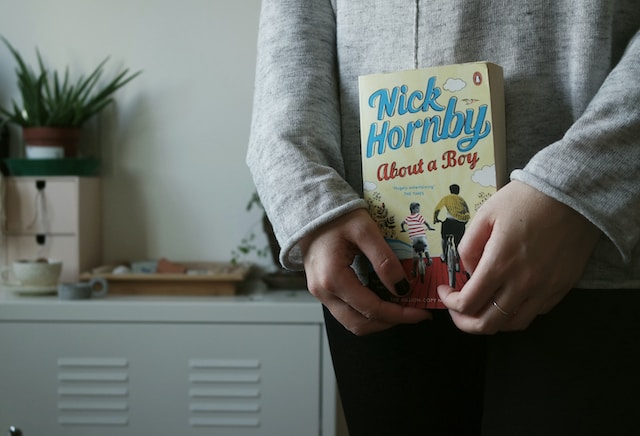
Hornby writes with the unnerving ease of someone who knows exactly how much wit a sentence can carry before it starts showing off.
About a Boy is built around a fairly simple comic premise. Will Freeman, an affluent, idle man in his thirties, invents a fictitious son so he can attend gatherings for single parents and improve his chances with women. Then he meets Marcus, an actual twelve-year-old boy whose unhappiness and social awkwardness make Will's carefully insulated existence rather harder to maintain. The plot matters, but Hornby's real achievement is in how lightly he handles it.
The prose is clean, conversational and rhythmically alert. Hornby has little interest in decorative language. He prefers the cadence of ordinary thought, allowing observations to arrive with the timing of a good joke. Contemporary reviews repeatedly singled out the novel's elegant, accessible prose and its sly humour, while also noting the care with which Hornby develops the emotional lives of his characters. That accessibility is not accidental. His sentences are engineered to disappear into the reading experience, carrying character and comedy without calling attention to themselves.
There is, however, a slight tyranny to all this fluency. Hornby is rarely at a loss for an amusing observation, and sometimes one wishes he would permit a scene to remain awkward without immediately finding the clever angle. The prose can become too polished in its conversationalism. Every irritation is neatly phrased. Every absurdity seems to arrive with its own punchline. The effect is charming until it becomes predictable.
His real strength is his control of perspective. Will's vanity is exposed without turning him into a cartoon, while Marcus's misery is treated seriously without drowning the novel in adolescent gloom. Hornby moves between their viewpoints with an instinctive understanding of how differently people interpret the same social world. He is particularly good at showing how self-interest can masquerade as principle, and how loneliness makes perfectly intelligent people behave rather foolishly.
And then, rather wonderfully, the humour begins to acquire emotional weight. The jokes do not merely decorate the story. They become a way of showing how these characters protect themselves from embarrassment, loneliness and disappointment. Hornby's comedy is at its best when it quietly reveals the insecurity underneath.
The prose is not ambitious in the grand literary sense, and occasionally its cleverness becomes a little too conspicuous. But that modesty is also its virtue. Hornby knows what kind of novel he is writing and rarely allows the language to become more important than the people.
Verdict: brisk, funny and deceptively controlled, with prose that makes emotional intelligence look almost effortless.