


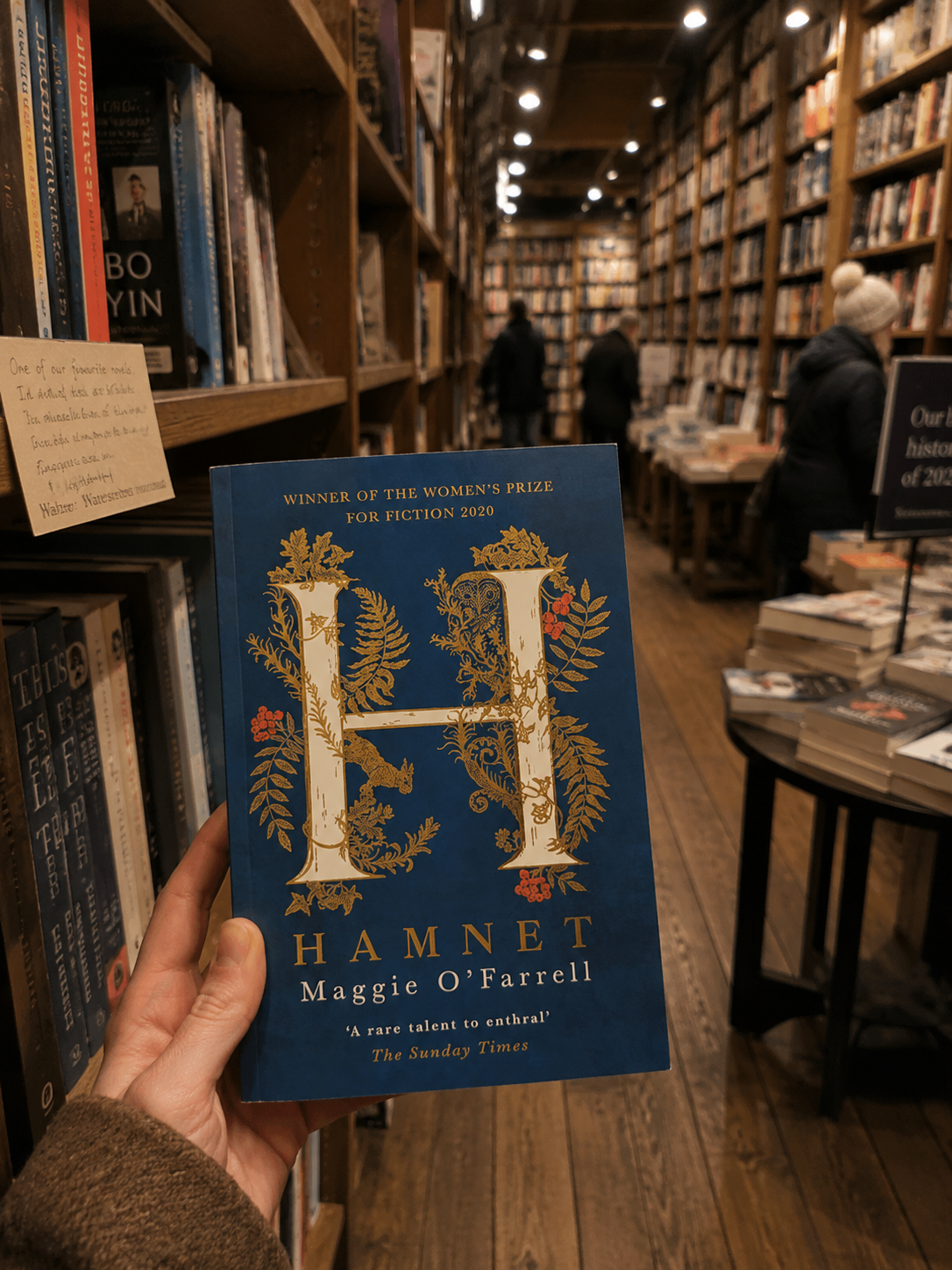
Hamnet by Maggie O’Farrell is historical fiction built around one of history’s most stubborn absences: we know that Shakespeare’s eleven year old son died in 1596, but we do not know how, what he was like, or what his death did to his family. O’Farrell takes that silence and fills it with an intimate portrait of Hamnet, his twin Judith, his sister Susanna, and especially his mother, Agnes, the woman more commonly known as Anne Hathaway.
The novel’s greatest strength is psychological. O’Farrell is less interested in the mythology of Shakespeare than in the ordinary people who had to live with his absence. Shakespeare himself is rarely named, and that choice is quietly brilliant. He becomes husband, father, tutor, sometimes an absence in the household, rather than the gravitational center of every scene. Agnes gets to have an inner life that history has largely denied her.
This matters particularly in the treatment of grief. The novel understands that bereavement is not simply sadness followed by recovery. Agnes becomes estranged from ordinary routines, from other people and eventually from parts of herself. Judith’s grief is different again, shaped by the peculiar experience of losing a twin. That specificity is one of the book’s most convincing achievements. Readers within bereavement communities have responded strongly to this aspect, with some bereaved parents describing the portrayal as unusually recognizable and others finding it less emotionally affecting than accounts written directly from lived experience. That difference is important: the novel can feel deeply observed without pretending that fiction can reproduce every experience of loss.
O’Farrell is also careful, mostly, about the imaginative freedom historical fiction requires. The surviving evidence about Agnes and Hamnet is painfully thin, so much of the family psychology is necessarily invented. The trouble comes when invention starts presenting itself with the confidence of fact. Hamnet’s cause of death is unknown, yet the novel makes plague central to his story. More significantly, the idea that his death inspired Hamlet is emotionally persuasive but historically unprovable, and recent Shakespeare scholarship has challenged the strength of that connection.
The book also occasionally romanticizes Agnes through her quasi mystical intuition and healing abilities. It is an appealing way to give a poorly documented woman agency, but it risks replacing one historical stereotype with another: the wise, instinctive woman who seems almost magically connected to nature.
Still, those reservations do not diminish what O’Farrell achieves with the family itself. The domestic details, sibling relationships and changing forms of parental love are exceptionally attentive. This is not politics standing in for characterization. The representation works because the characters are allowed to be contradictory, selfish, loving, frightened and occasionally wrong.
Content warnings include child death, grief, death, pregnancy and childbirth, illness and epidemic disease, physical and emotional abuse, animal death and violence. The child loss is central rather than incidental, so readers dealing with recent bereavement may want to approach it carefully.
Hamnet is ultimately a novel about the people left behind. Its historical inventions sometimes ask us to believe too much, but its understanding of grief asks us to feel rather than merely observe. That is where it is at its best.