


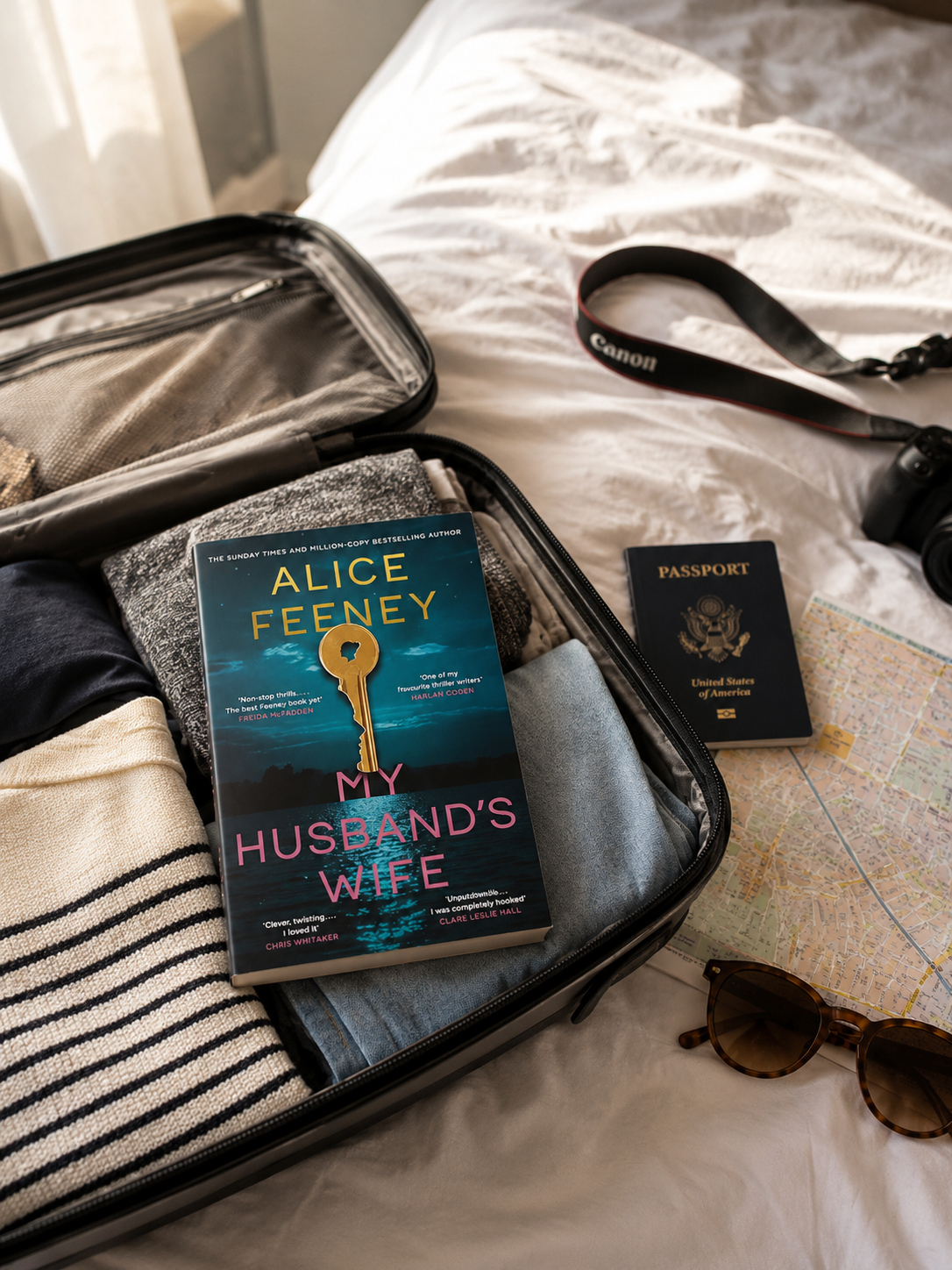
Packing for a trip always feels optimistic. You fold clothes with the assumption that the days ahead will unfold more or less as planned. A passport promises new places, a map suggests certainty, and a camera waits to preserve memories that haven't happened yet. The only unpredictable item in my suitcase was the novel tucked neatly between a sweater and a pair of jeans. Alice Feeney's My Husband's Wife turned out to be an amusing contradiction. It accompanied the beginning of a journey while telling a story that constantly reminded me how unreliable first impressions can be.
I've read enough psychological thrillers to recognize many of the familiar ingredients. A marriage carrying hidden fractures. Characters with carefully guarded secrets. Timelines that refuse to reveal everything at once. Yet Feeney manages to take those recognizable elements and arrange them in ways that remain difficult to predict. The novel doesn't rely solely on asking, "What happened?" It spends just as much time asking, "Who can you actually trust?"
The story follows Lily, a young lawyer whose professional life intersects with a disturbing criminal case while her personal life slowly grows more complicated than she initially understands. Running alongside her narrative is another perspective that appears disconnected at first, encouraging readers to look for links long before the novel is ready to provide them. Feeney is patient with those connections, allowing curiosity to build naturally instead of rushing toward immediate explanations.
What I appreciated most was the author's confidence in withholding information. Many thrillers mistake confusion for suspense, revealing so little that readers become detached rather than intrigued. Feeney avoids that trap. She shares just enough to keep every chapter productive while quietly encouraging readers to question the assumptions they have already made. More than once I found myself mentally revising earlier scenes after a seemingly minor detail suddenly took on new meaning.
The novel also benefits from characters who resist easy categorization. Very few people here are entirely sympathetic or entirely suspect. Instead, motivations shift as circumstances become clearer, creating an ongoing tension between what characters say, what they believe, and what they actually do. Lily, in particular, is compelling because she often appears confident professionally while remaining uncertain in the parts of life that matter most. That contrast gives her a vulnerability that feels believable rather than manufactured.
Feeney's writing style is economical without feeling sparse. She doesn't linger unnecessarily on description, preferring to keep scenes moving through dialogue, observation, and carefully timed revelations. That approach gives the novel a brisk rhythm, making it remarkably easy to continue reading long after intending to stop. I found myself repeatedly finishing one chapter only to justify another because each ending subtly shifted the direction of the story without relying on exaggerated cliffhangers.
One aspect that stood out was how effectively the novel explores the idea of identity within relationships. Marriage, friendship, professional success, and family all involve versions of ourselves that we choose to present to others. Feeney repeatedly asks whether genuine intimacy is even possible when people spend so much time protecting uncomfortable truths. Those questions give the story emotional texture beneath its suspense, preventing it from becoming simply a puzzle waiting to be solved.
The novel is not without its flaws. A handful of late revelations require readers to accept coincidences that stretch credibility slightly, and there were moments when I wished certain secondary characters had been developed further before their significance became apparent. Neither issue significantly affected my enjoyment, but both occasionally reminded me that the novel favors momentum over exhaustive realism.
What distinguishes My Husband's Wife from many books in the genre is that its twists rarely exist for spectacle alone. Looking back, most of them emerge from carefully planted details rather than arbitrary surprises. Even when I managed to anticipate one development, the reasons behind it remained satisfying because the emotional consequences mattered more than simply being shocked.
By the time I zipped the suitcase closed, I realized this had been exactly the right book to begin a journey with. Not because it was comforting, but because it captured that strange feeling of stepping into unfamiliar territory where confidence and uncertainty exist side by side. Every new destination asks us to pay closer attention to the world around us. My Husband's Wife asks readers to do much the same with the people inhabiting its pages.
For readers who enjoy psychological thrillers built on layered relationships, shifting perspectives, and carefully controlled suspense rather than relentless action, this is a rewarding choice. It is the kind of novel that quietly invites you to become a detective, rewarding close attention while reminding you that the most convincing stories are often the ones that persuade you to trust the wrong people first.