

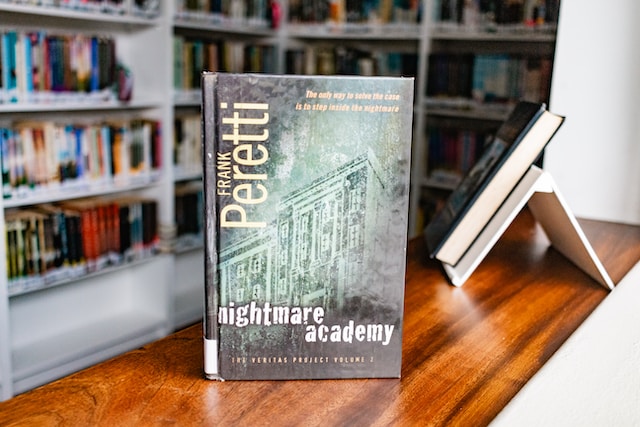
There are books that ask for silence.
Then there are books that make you suspicious of your own bookshelf.
I was tucked into my favorite corner at home, wrapped in a blanket with a cup of something warm close enough to forget and rediscover every few pages. It is the sort of place where stories usually feel softer than they really are. Reading Nightmare Academy there created an odd contrast. The room was all comfort and familiarity. The book kept insisting that familiar places are exactly where you should start worrying.
Frank E. Peretti's Nightmare Academy, the second and final novel in the Veritas Project series, follows twins Elijah and Elisha Springfield as they investigate a mysterious institution connected to missing teenagers, erased memories, and a growing conspiracy that blurs psychological suspense with supernatural ideas. Readers often remember the unsettling atmosphere, the emphasis on questioning what is presented as truth, and the novel's blend of thriller pacing with Christian themes.
Peretti has always trusted young readers with surprisingly big questions.
What is truth?
Who can you trust?
Why does every suspicious adult somehow own a building with deeply concerning architecture?
The mystery unfolds with real momentum, and the creeping sense that something is profoundly wrong arrives long before the explanations do. Peretti knows how to make ordinary conversations feel like someone has quietly hidden a monster behind the punctuation. It is wonderfully unsettling without relying on cheap horror, which explains why so many readers remember the atmosphere years after forgetting individual plot details.
The book's biggest strength is also the source of its occasional frustration. Its ideas arrive faster than its answers. Conspiracies stack on top of philosophical debates, which stack on top of action sequences, until your brain starts pinning imaginary strings between chapters like you're solving the case yourself.
You are not.
The book is.
Hopefully.
Then comes the dramatic pause.
I adjusted my blanket.
That was the most dangerous thing happening in my room.
Inside the novel, however, everyone was making life choices that would have me texting, "Absolutely not," from a safe distance.
What still works is Peretti's belief that critical thinking is not just an academic skill but a moral one. Beneath the suspense, Nightmare Academy keeps asking readers to examine authority, appearances, and easy answers instead of accepting them at face value. Sometimes that message feels a little louder than the story itself, but it is sincere enough that the novel never slips into feeling preachy for long.
If you enjoy YA thrillers that mix mystery with ideas and don't mind a story that occasionally asks your brain to work overtime, this is still an engaging ride. Just read it somewhere cozy. It is surprisingly satisfying to investigate nightmares while wrapped in a very nice blanket.