

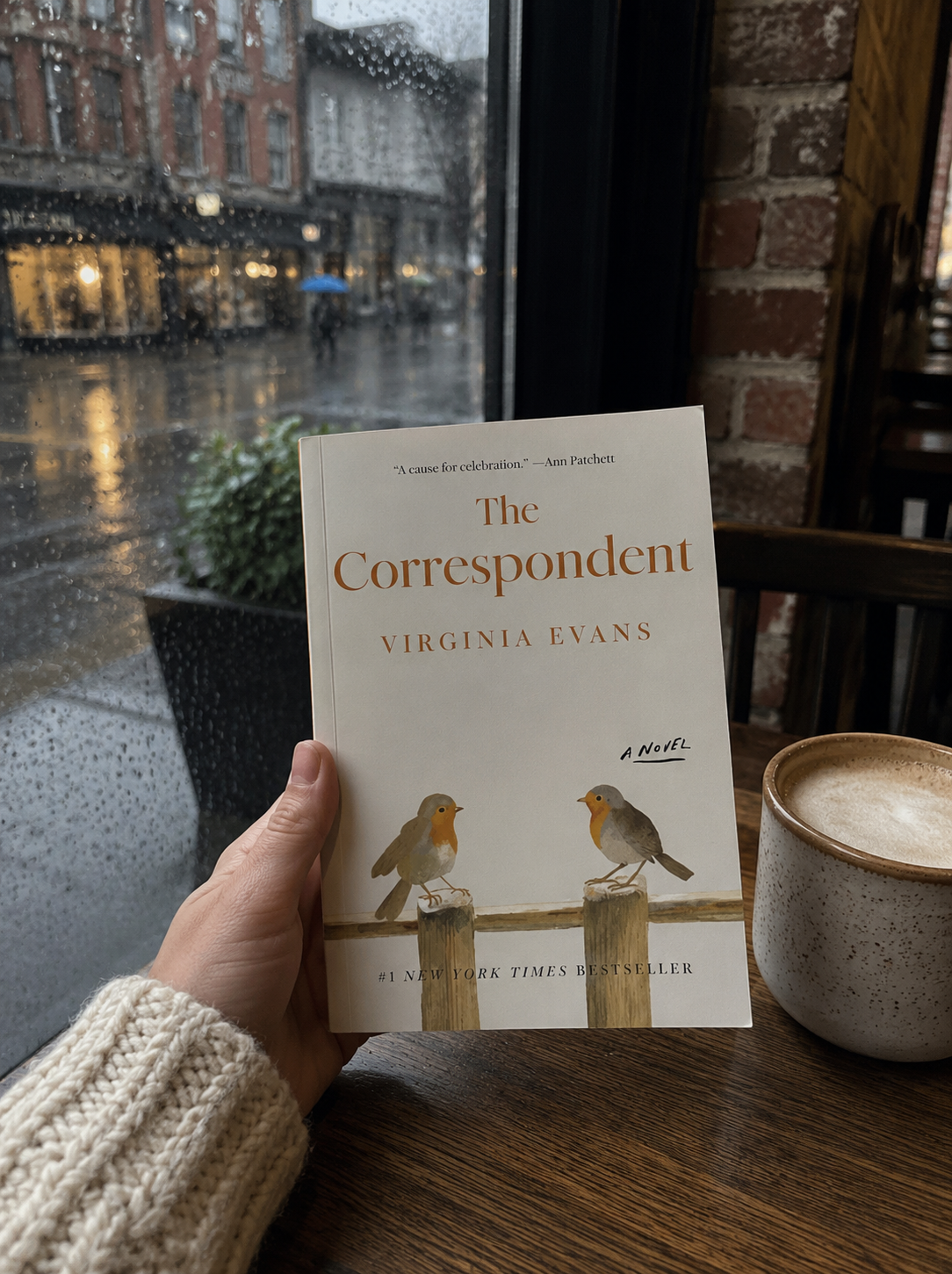
The rain had settled into a steady rhythm against the café window, soft enough to become background music rather than a distraction. Outside, people hurried beneath umbrellas, weaving through puddles with the quiet determination that rainy afternoons seem to demand. Inside, everything moved at a gentler pace. A cappuccino rested beside the book, sending up slow curls of steam, and for a while the world beyond the glass faded into little more than blurred lights and passing silhouettes. It felt like exactly the right setting to begin The Correspondent, a novel that invites you to slow down and pay attention to the conversations we often have through letters, memories, and the quiet spaces between words.
Virginia Evans builds her story around correspondence, but this is far more than a novel about letters. It is a thoughtful examination of loneliness, connection, and the complicated ways people reveal themselves when they have the time to choose every word carefully. Rather than relying on dramatic plot twists or constant momentum, Evans allows the story to unfold through relationships, observations, and emotional honesty. It is the kind of novel that asks for patience and rewards readers willing to settle into its rhythm.
The central premise immediately appealed to me because it embraces something increasingly rare in modern life. Letter writing creates distance, but it also creates reflection. Characters are given the opportunity to think before responding, to revisit memories before sharing them, and to express feelings that might never emerge in ordinary conversation. Evans uses that format not as a literary gimmick but as a natural extension of the emotional lives of her characters.
What impressed me most was the novel's quiet confidence. It never feels as though it is trying to manufacture significance. Instead, meaning accumulates gradually through small exchanges that reveal unexpected depth. A seemingly ordinary letter often carries years of regret, affection, uncertainty, or forgiveness beneath its surface. The emotional impact comes not from dramatic revelations but from the gradual realization that every character is carrying far more than they initially reveal.
The characters themselves feel remarkably authentic. They are imperfect in ways that are familiar rather than exaggerated. Misunderstandings arise not because people refuse to communicate, but because communication itself is often incomplete. Everyone brings different assumptions, different histories, and different fears into every exchange. Evans understands that relationships are rarely transformed by a single conversation. They evolve through consistency, patience, and the willingness to keep reaching out even when certainty feels impossible.
The prose reflects that same restraint. Evans writes with clarity and elegance without drawing unnecessary attention to her language. There are passages that linger because they capture something emotionally recognizable rather than because they strive to sound profound. I found myself rereading certain sentences simply because they articulated feelings that are difficult to express in everyday life. Those moments never interrupted the story. They became part of its quiet rhythm.
One of the novel's greatest strengths is its understanding of solitude. It distinguishes between being alone and being isolated, suggesting that meaningful connection is not measured by the number of people surrounding us but by the honesty we allow into our relationships. That idea appears repeatedly throughout the novel, each time from a slightly different perspective, giving the story a subtle thematic cohesion.
The pacing is deliberately measured, which may not appeal to every reader. Those expecting a plot driven by constant external conflict may find the novel understated. There were moments where I wished certain narrative threads moved a little more quickly, particularly in the middle portion. Yet looking back, I suspect that slower pace is essential to what Evans is trying to accomplish. This is a story that values reflection over urgency, and speeding it up would likely diminish its emotional resonance.
I also appreciated that the novel resists tidy emotional conclusions. Life rarely provides complete closure, and The Correspondent acknowledges that without becoming pessimistic. It suggests that understanding another person is an ongoing process rather than a destination, and that even incomplete conversations can change us in meaningful ways.
By the time I reached the final pages, the rain outside had finally begun to ease, though the window still shimmered with droplets catching the evening lights. It felt strangely appropriate. The Correspondent leaves behind a similar feeling, one of quiet clarity after a long period of reflection. It is not a novel that demands attention through spectacle. Instead, it earns it through empathy, careful observation, and a deep appreciation for the fragile ways people try to reach one another across distance, time, and silence. Readers who enjoy character-driven literary fiction that values emotional nuance over dramatic plotting will likely find themselves lingering with this story for long.