


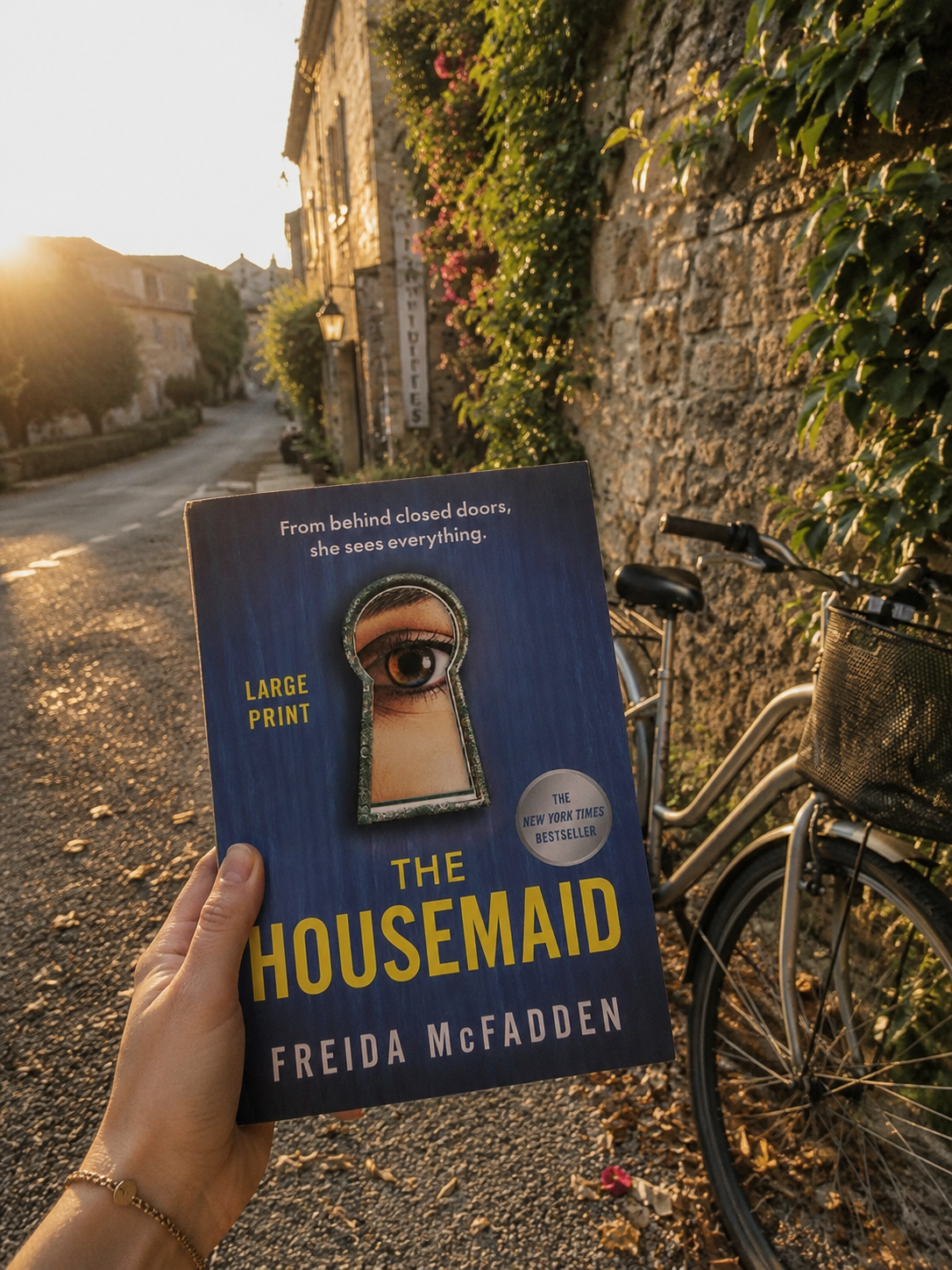
The evening sun had settled low enough to cast everything in shades of gold. An old stone lane stretched quietly ahead, climbing past ivy-covered walls and weathered buildings that looked as though they had been standing for centuries. A bicycle rested against the wall beside me, forgotten for the moment, while the last warmth of the day lingered in the air. It was the sort of place where every closed window seemed to hide a story.
Holding The Housemaid in that setting, I couldn't help noticing how perfectly its cover echoed the atmosphere around me. Behind every beautiful exterior, there was the possibility that something unsettling was waiting just out of sight. Freida McFadden has become one of the most recognizable names in contemporary psychological thrillers, largely because she understands how to transform familiar domestic spaces into places of growing unease. The Housemaid is perhaps the clearest example of that skill. The premise is straightforward. Millie accepts a position working as a live-in housemaid for a wealthy family, believing it offers a fresh start after a difficult past. It quickly becomes apparent that the household is anything but ordinary, and the tension begins long before the novel reveals its larger secrets.
What impressed me most was how efficiently McFadden establishes discomfort. The opening chapters rely less on dramatic events than on subtle inconsistencies. Conversations feel slightly off. Small details refuse to fit together. Characters behave in ways that seem explainable at first, only to become increasingly unsettling as more information emerges. That slow accumulation of uncertainty kept me turning pages far more effectively than constant shock would have.
Millie is an engaging narrator because she occupies an unusual position within the story. She arrives carrying her own history, one that gradually influences how readers interpret both her decisions and the people around her. McFadden avoids making her either completely vulnerable or unrealistically resourceful. Instead, Millie feels like someone trying to rebuild a life while navigating circumstances that become more complicated with every chapter. Her perspective encourages readers to question not only the people around her but occasionally her own assumptions as well.
The supporting characters are carefully constructed to keep readers uncertain. Without revealing specific plot developments, one of the novel's strengths is that nearly every significant interaction encourages a different interpretation depending on how much information you have at the time. Looking back after finishing the book, I found myself appreciating how many seemingly ordinary moments had quietly laid the groundwork for later revelations.
McFadden's writing style remains direct and highly readable. The chapters are brief, the pacing is brisk, and there is very little unnecessary exposition. This approach gives the novel an almost addictive quality. It is remarkably easy to tell yourself you'll stop after one more chapter, only to realize an hour has disappeared. The prose never attempts to draw attention to itself. Instead, it stays focused on maintaining momentum and building curiosity.
One aspect I particularly enjoyed was the novel's exploration of appearances. Much of the story revolves around assumptions people make based on wealth, social status, reputation, and first impressions. McFadden repeatedly reminds readers that domestic life often appears far simpler from the outside than it truly is. That theme runs quietly beneath the suspense, giving the novel a little more substance than its fast pace might initially suggest.
The twists are undoubtedly a major part of the reading experience, but what I appreciated most was that they generally feel supported by details planted throughout the narrative. Rather than introducing entirely new information at the last possible moment, McFadden encourages readers to reinterpret scenes they believed they already understood. That retrospective satisfaction is one of the novel's greatest strengths.
If I had one reservation, it would be that the relentless pace occasionally leaves limited room for deeper emotional exploration. Certain relationships and motivations might have benefited from a little more space to develop before the next revelation arrived. While this never undermined my enjoyment, there were moments where I found myself wanting to spend a little longer with the characters before the story shifted into its next surprise.
Still, the novel understands exactly what kind of reading experience it wants to deliver. It is suspense driven by uncertainty rather than complexity, making it highly accessible without sacrificing tension. McFadden keeps the narrative moving confidently, trusting readers to piece together clues while continually challenging their expectations.
As I closed the book, the sunlight had almost disappeared behind the old buildings, leaving the quiet street wrapped in long shadows. It felt strangely appropriate. The Housemaid is a reminder that appearances can be remarkably convincing until you look a little closer. Readers who enjoy psychological thrillers built around unreliable impressions, escalating tension, and carefully timed revelations will likely understand why this novel has attracted such a devoted following. It is fast, unsettling, and consistently entertaining, proving that some of the most compelling mysteries begin behind the front door of an ordinary-looking home.