


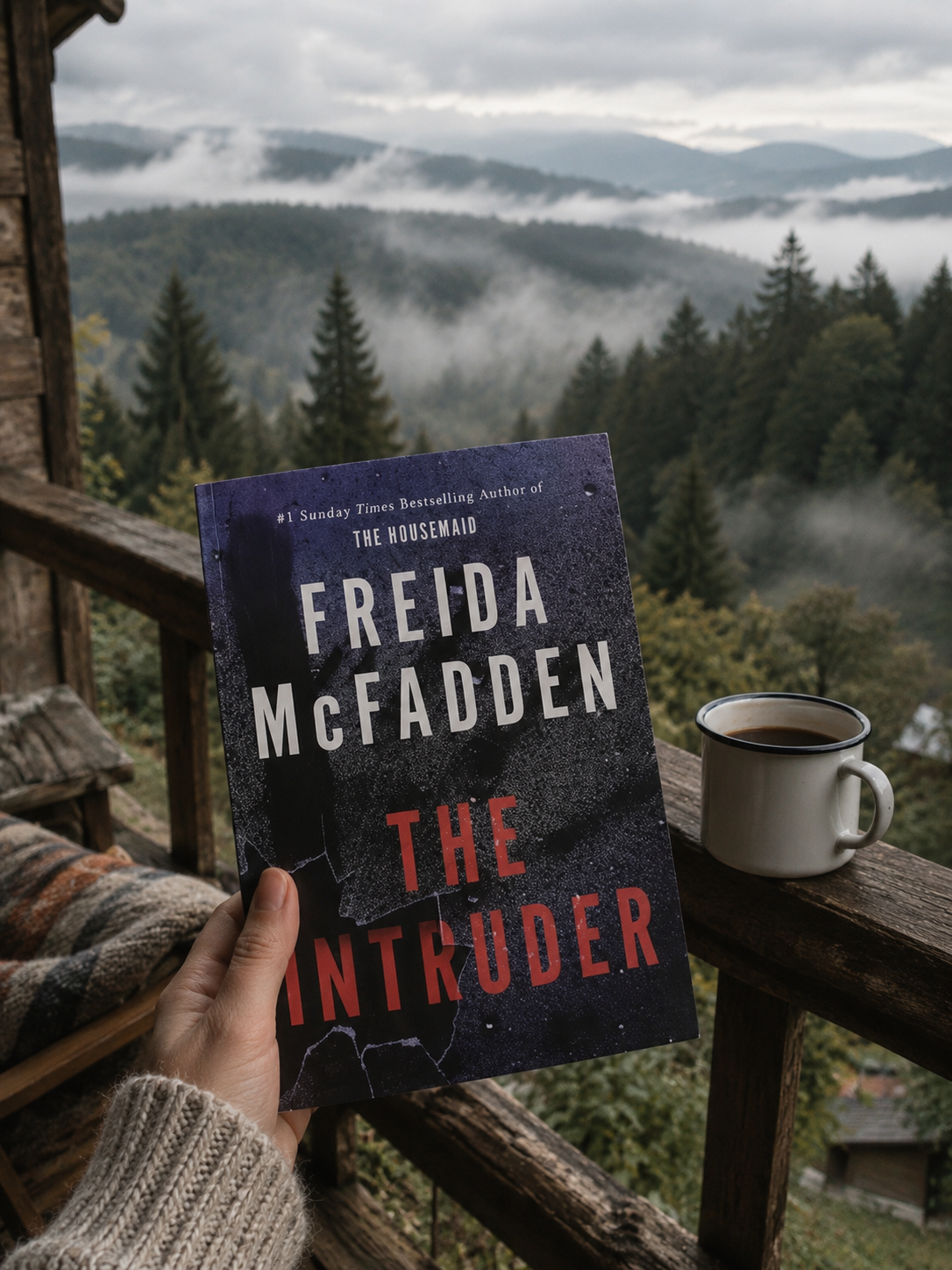
The rain had only just cleared when I stepped onto the wooden balcony with a mug of coffee that was still too hot to drink. Low clouds drifted lazily between the mountain ridges, wrapping the forest in strips of mist that moved almost imperceptibly. It was the kind of landscape that usually invites calm, the sort of place where every sound feels softened by distance. Yet the book in my hands had the opposite effect. Even before opening it, The Intruder seemed oddly out of place against such peaceful surroundings, as though it carried its own weather.
That contrast turned out to be surprisingly fitting.
Freida McFadden has built a reputation for writing psychological thrillers that waste very little time settling into routine, and The Intruder follows that same instinct. The premise is straightforward enough to draw you in quickly, but the real momentum comes from uncertainty. Every chapter quietly encourages you to question what you've just read, who deserves your trust, and whether seemingly ordinary moments are hiding something much darker beneath the surface.
What stood out to me most was McFadden's understanding of pacing. Rather than relying on constant shocks, she allows tension to accumulate through small disruptions. Conversations feel slightly off. Everyday observations begin to carry unexpected weight. By the time the larger twists arrive, they feel like the natural result of details that had been sitting in plain sight all along. Looking back, I found myself appreciating how carefully many of those clues had been planted.
The novel moves quickly, but not carelessly. Chapters are short and often end at precisely the moment curiosity peaks, making it remarkably easy to convince yourself that one more chapter won't hurt. Before long, that promise becomes ten chapters later. McFadden clearly understands the rhythm of modern thrillers and writes with readers' habits in mind. The story rarely lingers longer than necessary before introducing another question that demands an answer.
Her characters also contribute to the novel's effectiveness. No one feels entirely transparent, and that ambiguity becomes one of the book's greatest strengths. Motivations shift as new information emerges, forcing readers to constantly reassess earlier assumptions. While some supporting characters receive less development than others, the central figures remain compelling because they feel unpredictable without becoming implausible.
McFadden's prose is uncomplicated, which suits the genre well. She doesn't rely on elaborate descriptions or literary flourishes to create atmosphere. Instead, the tension grows from the situations themselves and from the psychological uncertainty surrounding the characters. The writing remains accessible throughout, allowing the narrative to maintain its pace without becoming weighed down by unnecessary detail.
That said, readers familiar with McFadden's work may recognize certain storytelling habits. A few developments arrive with the kind of dramatic precision that requires some suspension of disbelief, and there were moments when I anticipated a twist just before it unfolded. Even so, knowing something surprising is coming is very different from knowing exactly how it will happen. The enjoyment lies less in guessing the destination than in watching the carefully constructed route that leads there.
I also appreciated that the novel avoids becoming excessively graphic in its pursuit of suspense. The unease comes primarily from psychological tension rather than relentless violence. That approach made the story feel more immersive because it relied on imagination as much as action. Often, what remains unsaid proved more unsettling than what was explicitly revealed.
As I reached the final chapters, the mist outside had begun to lift, revealing layers of forest that had been hidden all morning. It felt strangely appropriate. The novel follows a similar pattern, gradually exposing truths that were obscured from the beginning, until the entire picture finally comes into focus. Some revelations genuinely surprised me, while others were satisfying because they rewarded careful attention rather than relying solely on shock value.
The Intruder is well suited to readers who enjoy psychological suspense driven by secrets, shifting perspectives, and persistent uncertainty. It is less concerned with complex literary exploration than with maintaining a steady sense of unease, and it succeeds because it rarely loses sight of that goal. McFadden once again delivers a thriller that is difficult to put down, not because it constantly demands attention through spectacle, but because it quietly convinces you that the next page might finally explain everything. More often than not, it simply gives you another reason to keep reading.


