

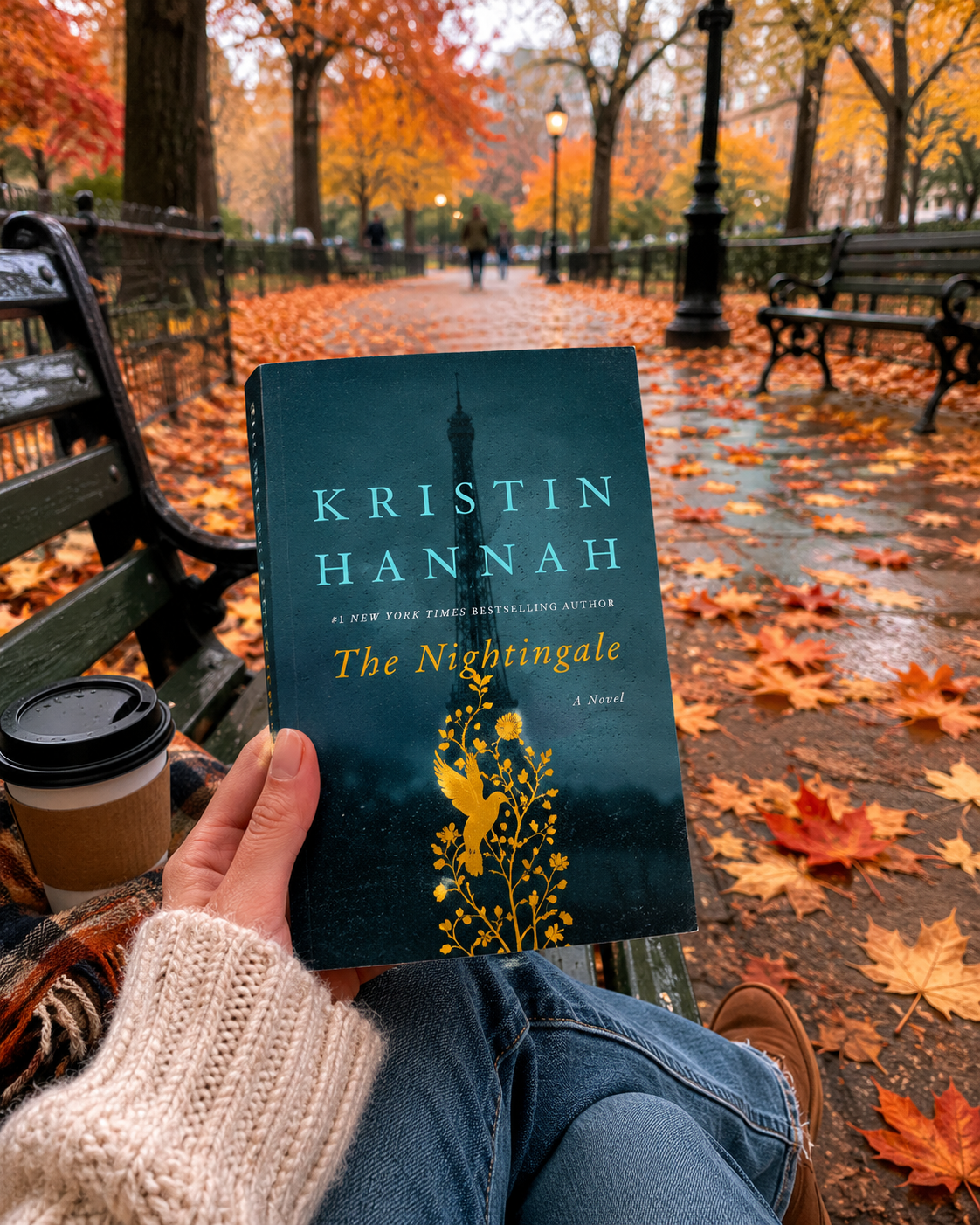
I reached the halfway point of The Nightingale and realized I had stopped paying attention to the park around me.
Children were running across the paths covered in autumn leaves, dogs chased one another between the benches, and people carrying coffee hurried through the crisp afternoon air. Life continued exactly as it should. Yet every time I looked up from the page, I found myself needing a moment to return to the present. Few novels have managed to create that kind of emotional displacement for me. Kristin Hannah doesn't simply tell a story set during the Second World War. She creates characters whose lives become so tangible that the distance between history and the present begins to disappear.
At its core, The Nightingale is a story about two sisters living in occupied France, each responding to war in profoundly different ways. Vianne seeks survival through caution, trying to protect her daughter and preserve what remains of ordinary life. Isabelle, younger and far more impulsive, refuses to accept passivity, choosing a path of resistance despite its overwhelming risks. Their relationship provides the emotional foundation of the novel, but what interested me most was that Hannah never presents either woman as morally superior. Instead, she explores the uncomfortable reality that courage rarely looks the same from one person to the next.
War novels often focus on battles, military strategy, or political leadership. The Nightingale deliberately shifts that perspective. Its attention remains fixed on kitchens, family homes, village streets, and ordinary people whose lives are gradually reshaped by impossible circumstances. Hannah asks what survival actually demands when every decision carries consequences, and whether bravery can sometimes mean simply enduring another day.
Both sisters are written with remarkable emotional depth. Vianne's choices frustrated me at times, particularly early in the novel, until I realized that was entirely the point. She isn't written to embody heroism. She represents the countless civilians forced into impossible situations where every option feels morally compromised. Isabelle, by contrast, burns with conviction from the beginning. She is passionate, reckless, and unwilling to surrender even when caution would seem the wiser path. Watching these two women slowly understand one another became just as compelling as the historical events unfolding around them.
Kristin Hannah has an instinct for emotional pacing that deserves recognition. She understands when to allow scenes to breathe and when to accelerate the narrative. Moments of extraordinary tension are often followed by surprisingly quiet chapters where characters simply process what has happened. Those pauses prevent the novel from becoming emotionally exhausting. They also make the larger tragedies feel more personal because readers have spent time getting to know the people experiencing them.
The prose itself remains accessible throughout. Hannah writes with clarity rather than ornamentation, allowing the emotional weight of situations to carry the story instead of elaborate language. Occasionally the novel leans toward sentimentality, particularly during a handful of climactic scenes, but I rarely felt that those moments crossed into manipulation. The emotions are earned because they arise from characters whose lives have been developed patiently over hundreds of pages.
One aspect I especially admired was the novel's portrayal of resilience. Hannah avoids presenting resilience as something grand or inspirational. More often, it appears through repetitive acts of responsibility, sacrifice, and quiet perseverance. The women in this novel are not constantly performing acts of visible heroism. They are making breakfast despite fear, protecting children, carrying secrets, comforting strangers, and finding ways to preserve fragments of humanity while surrounded by cruelty. Those quieter moments stayed with me far longer than many of the novel's larger dramatic scenes.
If I have one reservation, it is that a few emotional revelations arrive with a level of coincidence that slightly stretches credibility. The novel occasionally favors emotional impact over historical restraint. Yet even in those moments, the characters remain authentic enough that I found myself accepting the storytelling choices because they served the larger emotional truth Hannah was pursuing.
What makes The Nightingale endure is not simply its historical setting but its insistence that history is built from individual lives rather than abstract events. We often remember wars through dates, victories, and political figures. Hannah reminds us that every historical milestone also belonged to ordinary people trying to protect their families, preserve their dignity, and survive another day. That perspective gives the novel a lasting emotional resonance beyond its immediate story.
As the afternoon faded and the trees around me shed another layer of amber leaves, I finally closed the book and looked around the park again. The contrast was impossible to ignore. Everywhere I looked there was peace, conversation, laughter, and movement without fear. It made me appreciate the novel even more. The Nightingale is ultimately not about war alone. It is about the ordinary lives that war threatens to erase and the extraordinary strength required to protect them. Long after the final chapter, it leaves behind a renewed appreciation for both history and the quiet privileges of everyday life that are so easily taken for granted.