


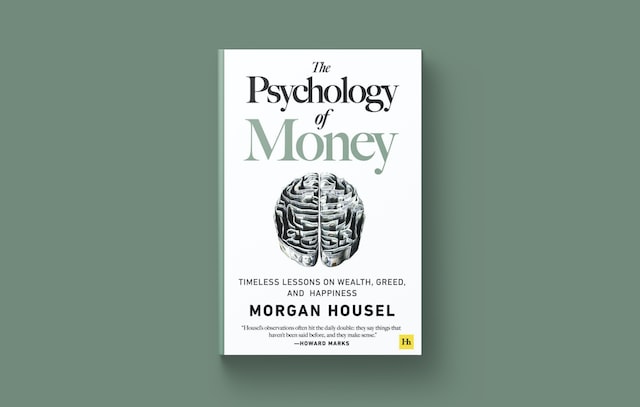
A financial writer takes nineteen short stories about wealth, risk and greed and turns them into an argument that the hardest part of managing money is managing yourself.
The Psychology of Money, published in 2020, is best classified as behavioral personal finance rather than a conventional investment guide. Housel's opening chapters establish the book's central idea quickly: financial decisions are shaped by personal history, incentives, emotion and circumstance, so being intelligent with numbers does not automatically make someone intelligent with money. The book then develops that argument through compact, self-contained essays.
For this genre, the pacing is excellent. Housel understands that financial advice becomes exhausting when every chapter starts sounding like a lecture. His chapters are short, his examples do most of the explanatory work, and the prose has been widely praised for its clarity and accessibility. The result is unusually easy to move through without feeling intellectually empty.
The weakness is that the structure can become predictable. Housel repeatedly introduces a counterintuitive observation, illustrates it with a story, then distils it into a memorable principle. It is an effective rhythm, but after enough repetitions, the technique becomes visible. Readers looking for detailed investment mechanics will also find the book intentionally light on them. Its subject is behaviour, not portfolio engineering.
Compared with How I Invest My Money, published the same year, Housel's approach is broader and more philosophical. Beside The Behavioral Investor, it is considerably more conversational and less technical. That makes it especially effective for readers who need to rethink their relationship with money rather than learn another set of financial formulas.
The ending holds because Housel does not suddenly promise mastery. He returns to the quieter goal of building a financial life that leaves room for uncertainty, patience and freedom.
This is smart, disciplined financial writing that knows when to simplify without becoming simplistic. It is not the final word on money. It is a very good corrective to the assumption that money is mainly a mathematical problem.