


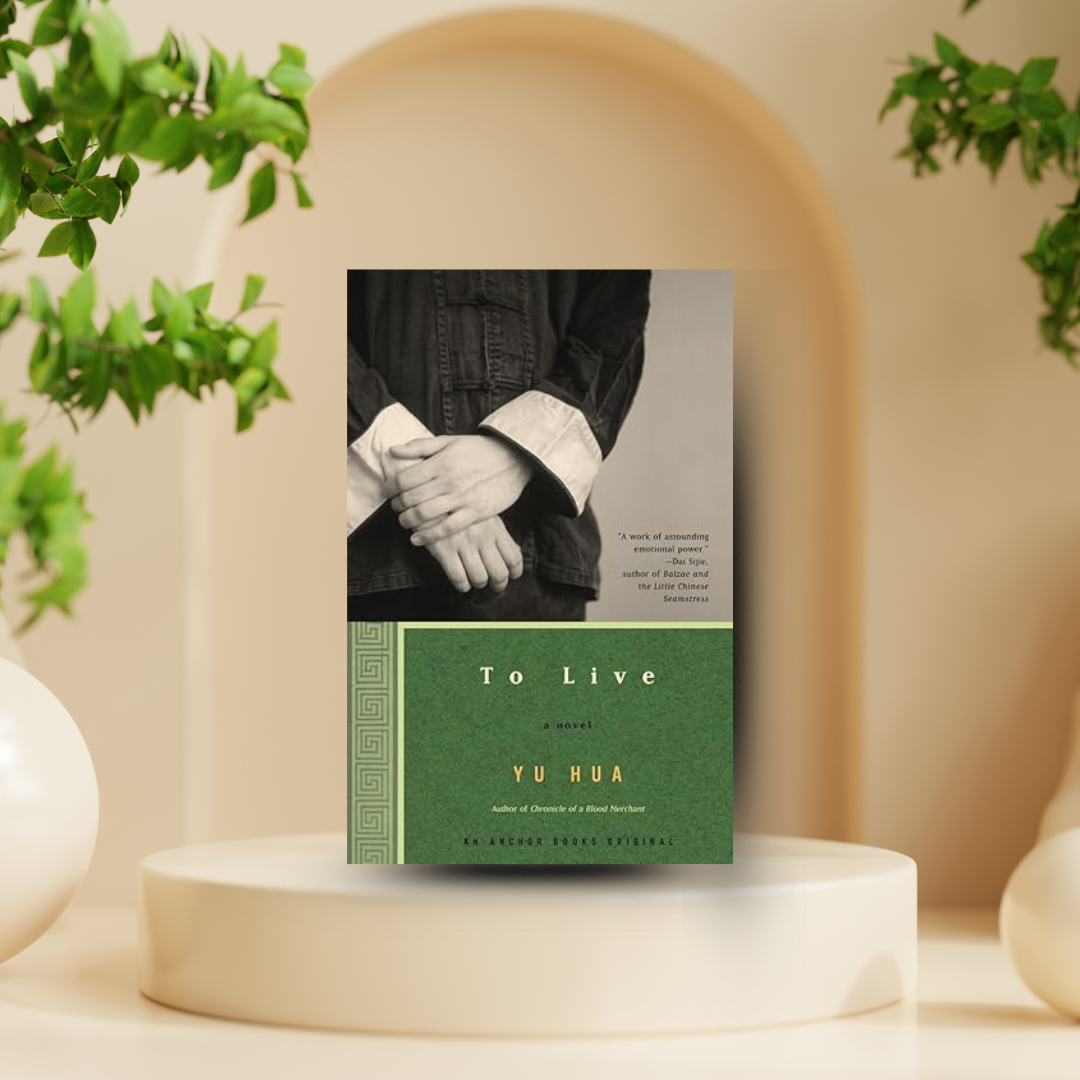
Yu Hua’s To Live is a novel of haunting simplicity and emotional power, a work that compresses the turbulence of twentieth-century China into the intimate story of one man’s endurance. First published in 1993, the book has since become a cornerstone of modern Chinese literature, admired for its spare prose, moral depth, and profound humanism. It tells the story of Fugui, a man whose life unfolds from privilege to destitution, from arrogance to humility, and ultimately from despair to a kind of spiritual peace. Through his story, Yu Hua captures not only the individual’s struggle against fate, but also the collective trauma of a nation in relentless transformation.
At its heart, To Live is a story about survival and the stubborn persistence of life itself. The narrative begins with Fugui as a young, irresponsible landowner, whose prodigal habits lead to his family’s ruin. He gambles away his inheritance and loses everything, forcing his family into a life of poverty. Yet, the novel’s brilliance lies not in the melodrama of his downfall, but in the quiet dignity of what follows. Fugui’s journey from wealth to hardship mirrors the broader trajectory of China as it moves through revolution, war, and reform. His life becomes a vessel for the suffering and endurance of millions.
Yu Hua’s prose is deceptively simple, written in a voice that feels both intimate and detached. The narrator, a traveling storyteller, listens to Fugui recount his life in plain, unembellished language. This framing device creates a sense of oral history, as though the reader is being entrusted with a sacred confession. The rhythm of the storytelling is measured, even understated, which allows the emotional weight of events to emerge naturally rather than through overt sentimentality. When tragedy strikes—and it does repeatedly—the reader is not bludgeoned by pathos but rather moved by the quiet inevitability of loss. In this restraint lies the novel’s greatest power.
The historical backdrop of To Live spans some of the most turbulent decades in Chinese history, from the Republican era to the Cultural Revolution. Yet Yu Hua never lets history dominate the narrative. Instead, it seeps into the story through the texture of everyday life: the hunger, the fear, the absurdities of political zeal. Fugui’s experiences with the Nationalist army, his forced labor during collectivization, and his witnessing of the Great Leap Forward’s devastating consequences all unfold as natural extensions of his personal misfortunes. The political becomes personal, and the personal becomes universal. In Yu Hua’s hands, history is not a grand spectacle but a series of intimate catastrophes.
What distinguishes To Live from many novels about suffering is its profound moral vision. Yu Hua refuses to turn misery into a spectacle or to offer easy redemption. The novel’s emotional impact lies precisely in its refusal to sentimentalize pain. Fugui does not emerge from his suffering ennobled or enlightened in any conventional sense. Instead, he learns to accept life as it is, stripped of illusion or expectation. This acceptance is not resignation but a kind of grace. By the end, when Fugui lives alone with his aging ox, his quiet companionship with the animal embodies the endurance of life itself. The ox is a mute witness to everything that has passed, and in its presence, one senses a faint glimmer of peace amid desolation.
Yu Hua’s handling of irony and humor is another remarkable aspect of the novel. Even in the bleakest moments, there are flashes of absurdity that reveal the resilience of the human spirit. Fugui’s naive optimism, his ability to find small joys amid catastrophe, becomes a form of resistance against despair. The humor never undermines the gravity of events; rather, it enriches them, showing that laughter can coexist with suffering. This tonal complexity prevents the novel from collapsing into bleakness. It allows readers to experience empathy without pity and to see endurance not merely as survival but as a quiet act of defiance.
The translation by Michael Berry deserves special mention. Berry’s English rendering preserves the directness and rhythm of Yu Hua’s Chinese prose, conveying both the colloquial flavor of Fugui’s voice and the lyrical undertones that shimmer beneath the surface. The simplicity of the language conceals a deep poetic sensibility. Sentences unfold with the unhurried cadence of oral storytelling, yet each image is sharply etched. In this clarity lies the novel’s emotional immediacy. Nothing feels forced; everything flows from the natural rhythms of memory and speech.
To Live also stands out for its ethical dimension. It asks what it means to live in a world where suffering is unavoidable, where history and fate conspire against individual happiness. Yu Hua’s answer is both tragic and hopeful. Life, he seems to suggest, has no grand meaning beyond the act of living itself. To live is not to triumph, nor to transcend, but simply to endure—to continue breathing, remembering, and caring, even when all else has been taken away. In this sense, the novel is both deeply Chinese and universally human. It echoes the stoic wisdom found in ancient philosophy and the existential defiance of modern literature.
The novel’s emotional resonance is amplified by Yu Hua’s deep understanding of loss. Each death in Fugui’s family is presented with devastating simplicity. His wife Jiazhen’s quiet strength, his son Youqing’s tragic accident, his daughter Fengxia’s gentle perseverance—all are rendered with tenderness and restraint. Their deaths are not used for dramatic effect but accepted as part of the inexorable rhythm of life. By the end, Fugui’s solitude feels both unbearable and serene. His survival is not heroic but profoundly human.
In literary terms, To Live represents a significant evolution in Chinese fiction. Yu Hua, who began his career as an experimental writer influenced by Western modernism, found in this novel a new form of realism—one that blends personal testimony with allegory. The book’s structure is simple, almost circular, reflecting the cyclical nature of life and suffering. Yet within that simplicity lies immense depth. Yu Hua’s realism is not political propaganda nor nostalgic idealism; it is a moral realism, grounded in empathy and truth.
Reading To Live is an experience of quiet devastation. The novel leaves one humbled by the resilience of ordinary people and haunted by the question of what it truly means to endure. Yu Hua achieves something rare: he transforms the brutality of history into a meditation on the dignity of survival. Every page seems to affirm the fragile beauty of being alive, even in the face of unimaginable pain.
Ultimately, To Live is not merely a story about one man’s life; it is a universal elegy for the human condition. It reminds us that to live is to remember, to suffer, and to hope, often all at once. In its unadorned language and unflinching honesty, Yu Hua’s masterpiece captures the paradox of existence itself—the persistence of life amid loss, and the quiet grace of simply continuing. Few novels achieve such purity of vision or such profound emotional truth.
In the end, when Fugui sits beside his old ox, talking to it as if it were family, the reader feels the full weight of everything he has endured. What remains is not despair, but a deep, aching peace. The world may be merciless, but life goes on. And that, Yu Hua suggests, is enough.