

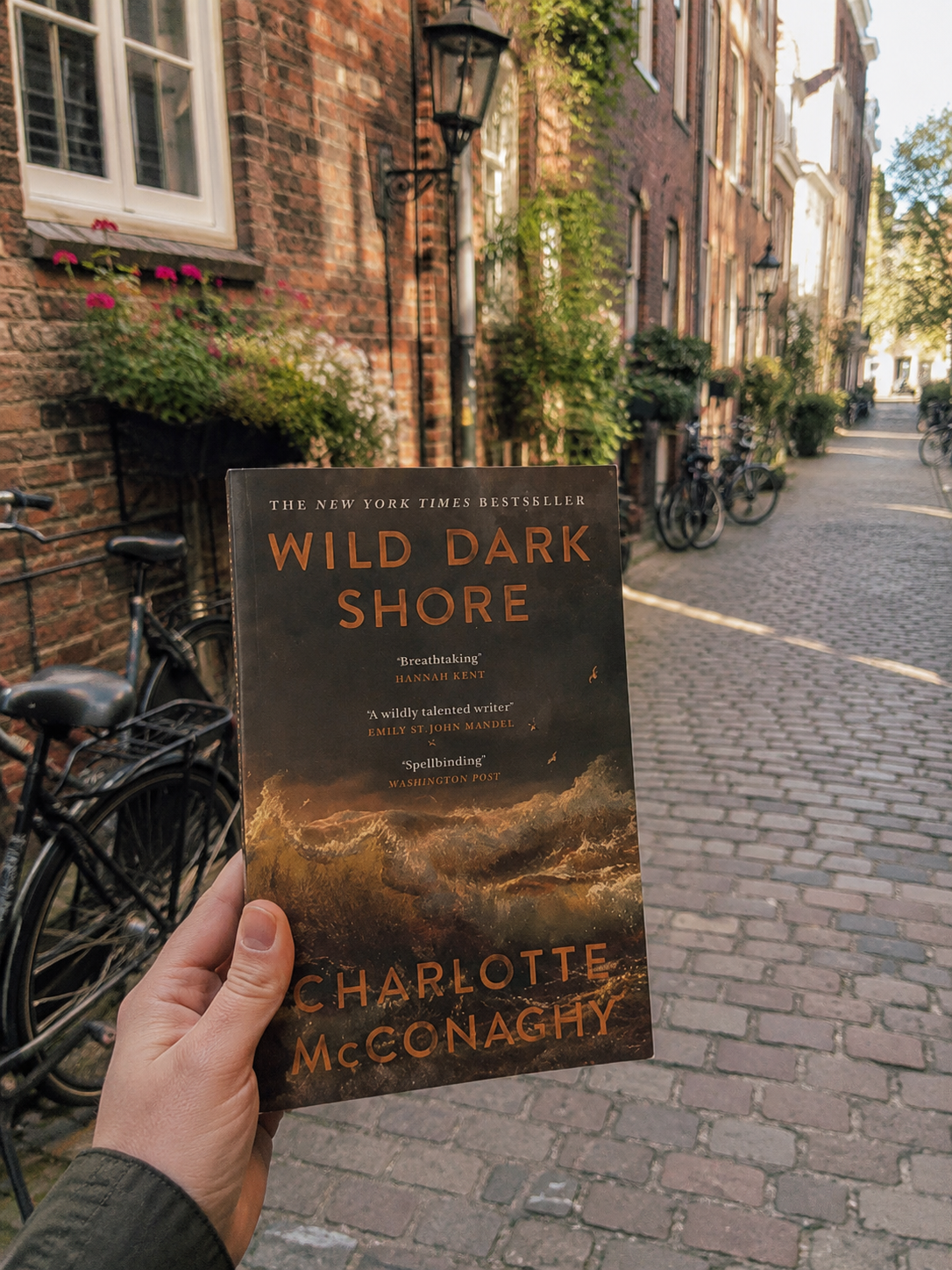
Before I opened the first page, I found myself lingering in the narrow cobbled street a little longer than I expected. The afternoon light had settled softly against old brick buildings, bicycles rested casually along the walls, and the whole place carried the kind of quiet that makes you slow your pace without realizing it. It felt like the sort of street where stories naturally belong, where every weathered doorway suggests a history you will never fully know. Standing there with Wild Dark Shore in my hand, I couldn't help thinking that some novels seem to ask for a particular atmosphere before they reveal themselves. Charlotte McConaghy's latest felt like one of them.
I came to this book expecting another environmental novel in the vein of Migrations and Once There Were Wolves. McConaghy has developed a reputation for weaving ecological concerns into deeply personal narratives, and I was curious to see whether she would revisit familiar territory or take a different emotional path. What I found was a novel that shares the same concerns as her earlier work but approaches them with a quieter, more intimate confidence.
Wild Dark Shore unfolds with an undercurrent of mystery, though it never becomes defined by suspense alone. The story gradually reveals itself through the lives of characters who are carrying private griefs while inhabiting a landscape that feels both breathtaking and unforgiving. McConaghy has always been particularly skilled at treating nature as something far more than scenery, and that ability is on full display here. The environment shapes decisions, relationships, and emotional states without ever feeling like a symbolic backdrop. It is living, unpredictable, and indifferent in ways that make the human drama feel even more fragile.
What struck me most while reading was the novel's patience. It refuses to rush emotional revelations. Instead, it allows relationships to develop through observation, silence, and small gestures that accumulate meaning over time. There were moments when I found myself slowing down, rereading a paragraph simply because the emotional shift was so subtle that I wanted to appreciate how McConaghy had arrived there. It is a novel that rewards attentiveness rather than speed.
The characters are drawn with remarkable restraint. No one feels entirely knowable at first, which mirrors the experience of meeting people in real life. Initial assumptions gradually dissolve as histories surface and motivations become clearer. I appreciated that McConaghy avoids simplifying grief into something easily resolved. Each character carries loss differently, and those differences shape the rhythm of the narrative more than any dramatic plot twist.
The prose is one of the book's greatest strengths. McConaghy writes with precision rather than excess. Her descriptions are vivid without becoming ornamental, and she has an instinct for knowing when a single image can communicate more than an entire page of explanation. The natural world is rendered with such careful attention that I often found myself pausing to picture it before continuing. Yet those descriptions never interrupt the story. They deepen it.
The pacing may not suit every reader. This is not a novel driven by constant revelation or relentless momentum. Its tension comes from uncertainty, emotional vulnerability, and the gradual uncovering of what its characters have been unable or unwilling to say. There were sections in the middle where the deliberate pace tested my patience slightly, particularly because I was eager to understand how several narrative threads would eventually connect. Looking back, though, that slower progression feels intentional. It encourages the reader to inhabit the same emotional space as the characters rather than simply observe them from a distance.
One aspect I particularly admired was the novel's refusal to separate environmental concerns from human experience. Climate, isolation, extinction, and belonging are not presented as abstract ideas. They exist within everyday choices and relationships. McConaghy trusts readers to recognize these themes without constantly drawing attention to them, which gives the novel a quiet confidence.
Emotionally, Wild Dark Shore stayed with me in unexpected ways. It is less interested in delivering dramatic moments than in exploring what people do when they have exhausted certainty. There is melancholy throughout, but it is balanced by compassion and an enduring belief that connection remains possible even after profound loss. That balance prevented the novel from becoming emotionally overwhelming. Instead, it felt reflective and deeply humane.
Closing the book, I found myself thinking less about individual scenes than about the atmosphere McConaghy creates. Like that peaceful street where I first opened its pages, the novel invites you to slow down and pay attention to what often goes unnoticed. It is a story that values quiet observation over spectacle and emotional honesty over easy resolution. Readers who enjoy literary fiction rooted in place, character, and the complex relationship between people and the natural world will likely find much to appreciate here. It is the kind of novel that asks for your patience, then rewards it with a lingering sense of stillness that remains long after the final page.